
Eduardo Risso: More Than Hundred Bullets!
A conversation with Eduardo Risso about his journey from Argentina to the United States market, with a detour in Europe.

The last newsletter covered an unplanned topic, so today I'll be celebrating Easter by resurrecting an old interview conducted two decades ago with Eduardo Risso. This will allow me to start featuring content here that focuses on the positive aspects of comics, instead of the culture wars and social misdeeds of comics authors.
The interview was originally conducted in Spanish, with a Portuguese version published on a webzine and an English version on my site. Unfortunately, both sites have disappeared into the ether, so the interview will be available here.
Born in 1959 in the province of Cordoba, Argentina, Eduardo Risso began his career in 1981. Since then, he has made significant strides in both the European and American markets, winning several awards, including the Eisner, Harvey, and Yellow Kid for his work on 100 BULLETS with Brian Azzarello.
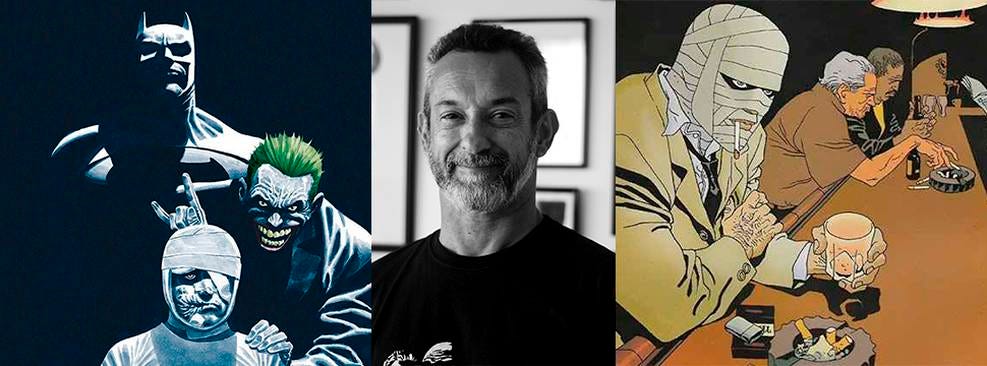
Miguel Ardan: How did you manage to get your first professional work?
Eduardo Risso: I had to travel to Buenos Aires where all the publishing houses were. I was born in a little village in Argentina's countryside and all the publishing houses were in Buenos Aires. Basically, Argentina is Buenos Aires, a big city from where everything comes. So, I went to the publishing houses, but they sent me to work as an artist's assistant so that I could learn. I had a basic idea of how to do comics, and I had a drawing style, but I still had a lot to learn. That's how I started working as an assistant.
I must recognize I learned little as an assistant, because all the artists had different styles, and none was interested in sharing their knowledge.
Until I was lucky enough to go to a course taught by the great master Alberto Breccia. That course went on for six months, but I drew very little, very little really. All the others drew, while I sat talking to Breccia. He opened his mind to me and taught me what I couldn't have learned in all my life. From then on, I started experimenting and creating my drawing style. But, at that time, I was already working for Argentina's biggest publishing - Columba.
MA: You did several short stories for Columba.
ER: I started with a movie adaptation for Columba, and then they gave me a series, but I had to follow Mandrafina's style because the publishing house would ask all the completely formed artists to follow the drawing style of someone they thought of as a "star". That's how I started with Mandrafina's style because I liked his black-and-white work; he was one of the best at the time.


MA: Was PARQUE CHAS, written by Ricardo Barreiro, the first big story you did?
ER: When I did PARQUE CHAS for the Fierro magazine (edited by a publisher that emerged in the 80s and provided an alternative to the Columba and Record publishers, who were rivals themselves), there was an island of liberty both in terms of the story and the art
It was very difficult to start working at the Fierro magazine, mainly because I was already committed to a regular series with Columba, collaborating with the writer Robin Hood. They assumed I would continue in a similar vein, but I managed to secure a position and ended up working on PARQUE CHAS.
MA: What was the story?
ER: It wasn't simple. The idea was to tell several stories all with the same element of connection between them: a reporter who would question the Parque Chas' dwellers. Parque Chas is one of Buenos Aires' quarters and it has the particularity of having round houses, circles that close in progressively smaller circles, all converging to the center. And all those houses have another particularity: if you take your car, you can only leave through the single avenue that cuts right through the middle of the quarter. It's a very small quarter made by request of a man named Chas. It allowed us to tell amazing stories that mostly never happened. In PARQUE CHAS there were historical characters like Peron (the President of Argentina). We told a story about Peron building a tunnel that ended in Parque Chas. It was impossible! Because it was too far from the House of Government. The tunnel was never finished because uncanny things happened inside it. All things were made up by Barreiro, who would take reality and add the uncanny to it, creating many interesting stories.
MA: What was it like to work with Ricardo Barreiro, who was not only a writer but also already an acclaimed artist at the time?
ER: Well, he was the one who called me to work with him. He had seen my drawings, and he liked them, and the same happened when I worked with Trillo and now with Azzarello in 100 BULLETS.
As an artist, I believe it's important to demonstrate to the writer (or at least that's my perspective) that they can rely on me to contribute to the narrative through the visual aspect. I aim to show them that they can afford me some creative freedom and trust me to convey their ideas visually. Essentially, I believe that while some aspects of the script are best conveyed through text, others can be effectively communicated through drawings.
MA: The characters' emotions, their expressions?
ER: No. The greater part of the story. With 100 BULLETS, and now with BATMAN too, what happens is that Azzarello hands the script to me, I read it and then I have enough freedom - from Azzarello - to place the characters in the place and environment I choose, for as long as I don't change the story. For instance, if I think that the images of the story get boring when they're seen, then I add an alternative story - I've always done that; with Trillo, Barreiro, and now Azzarello.
For instance, there's a conversation between two individuals in a room and it goes on for eight pages. This gets boring for the reader - I'm saying this because I was a comic book reader - to me, it was and still is about two characters talking all the time in the same place, and then you get to the point where you can tell what's going on outside and outside could be this great story for a graphic tale.
MA: You're referring to a story that isn't outlined in the script, but incorporating it doesn't change the narrative but enhances the visual appeal of the page?
ER: Exactly! In the first issue, there was this story where I introduced a character that we had used in JOHNNY DOUBLE.
JOHNNY DOUBLE ends with a character fleeing to Chicago with a substantial amount of money. Since 100 BULLETS began in Chicago, there was a scene between Mr. Graves and Dizzy Cordova inside a train, set in Chicago. I faced a dilemma regarding what images to use: merely depicting the city would be boring. Instead, I opted to include a subplot where the other character is mugged and robbed of the stolen money. This addition wasn't part of the original script. Azzarello and Alonso [Vertigo's editor at the time] were surprised by the creative choice.
And that's how I earned their trust, allowing Azzarello to depend on me for a significant portion of the visual storytelling. In issue number five, there's also a scene between Megan Dietrich and the barman who's supposed to kill her. I incorporated a subplot taking place in another building, where a man was facing trouble with dealers, and then a helicopter would show up to take him down.
When Azzarello saw the penciled pages, he said, 'What a great idea to introduce Lono, a character who's going to appear in issue eight, but we can bring him in earlier, in issue five. This way, we're introducing a character from a later issue without the readers expecting it!'
The readers believe it was Azzarello's idea, but creating an alternative story was my idea. I often do this: when I find that the main story lacks visual interest, I introduce an alternative subplot that can enhance the overall narrative.
MA: Going back a bit, before 100 BULLETS and BATMAN, when did you start working with Carlos Trillo and how did you end up working in Italy?
ER: Trillo, he called me; but I had already started working in Italy, through some agents in Argentina. I was working on this story - one that I'd rather forget - called AZOR, which was essentially a poor imitation of a character named HENGA. The story was published in both Italy and Argentina. I was well into this project when Trillo contacted me because he wanted to collaborate on FULÙ. However, it took us a year to begin working on FULÙ due to my prior commitment to those other publishers. Once we started on FULÙ, it was a direct collaboration between us and Italy, without any involvement of agents.
This marked my first collaboration with Trillo, and from then on, we developed a strong symbiotic working relationship.


MA: With Trillo, you created 5 volumes of FULÙ. What was the public's and the French publishers' reaction to your work in FULÙ?
ER: I never worked directly in France. I was never charged with doing something from France. Our work [Trillo's and Risso's], all the work we did was to Italy and then sold to France. It was all done that way.
MA: Even though you have work published in France, it was all done for Italy?
ER: Yes, it was during that period that Glénat commissioned me for SIMON, UNE AVENTURE AMÉRICAINE. Initially planned as a series of several colored volumes, it ended up being a single black-and-white volume due to the publisher's crash in France, which occurred in 1992.
It was a disaster! Several magazines got canceled and they couldn't pay. SIMON ended up as a single black-and-white volume and because we couldn't sell it to France, we produced it to Italy.
MA: Was it then that you started working for the United States?
ER: No. The United States happened much later when I was doing CHICANOS.


MA: You started publishing in the United States with the comic adaptation of ALIENS: RESURRECTION. How did the opportunity come about?
ER: I went to San Diego. In '85, I went to the United States to... I've always shied away from the United States - I must admit it - because I love the European market. I appreciate the publications in France and the way they're presented. It's more pleasing to the eye. The workload is lighter, and you have more time to work in the French market. Producing a 48-page book in 6 months and working on a monthly series in the United States are two entirely different experiences. The American market is much more dynamic, with a higher production rate.
I was fortunate to work in Italy, where there was a very rigorous working rhythm. For example, with CHICANOS, I had assistants. My first experience working with assistants was on BOY VAMPIRE, and I didn't enjoy it. However, I continued with BORDERLINE and CHICANOS, producing 48 pages every month with the help of assistants.
I mean, when I entered the American market, having to produce 22 pages every month felt like child's play to me! Right now, I'm working on 100 BULLETS and BATMAN almost simultaneously. But for me, creating those 22 pages for the American market doesn't take more than 6 to 7 hours of work from Monday to Friday, leaving me with a free weekend.
MA: You started your career as an assistant. How was your relation to your assistants when you needed them?
ER: It was a completely different experience because I had already endured the challenges of being an assistant, and I didn't want my assistants to go through the same struggles. When I began working with assistants, I understood that I was at a stage where I could impart knowledge. I was in my mid-30s. I was 34 and I said "Dammit! Right now, I have the condition to pass on this knowledge. How can I do it? So that, somehow, it doesn't get lost but helps to provide new artists with better training!"
Well, it became somewhat of a necessity because I needed assistants, and since I had them, I decided to teach them. Now, I have several assistants who have become professionals, and I feel fantastic about it! We're friends. I believe you can cultivate that dynamic—having assistants and mentoring them—even if they eventually move on.
We don't have to retain them because there isn't a career path as an assistant. There are established careers for pencilers, inkers, colorists, and writers. But assistants? It only exists for the assistants to finish their training.
MA: Marcelo Frusin, Leandro Fernandez, and Francisco Parozinni were your assistants. Do you feel you've influenced them in some way?
ER: It's inevitable that I influenced them. It's inevitable because they work with someone for so long, and they're not completely formed yet, and they have the need to learn. And if there's someone at their side who can show them the way, then it's inevitable that they end up being influenced. But they're smart enough to let go of it. I think Marcelo, for instance, is doing it; in the beginning, he resembled me a lot, and now he's becoming different, little by little, and I'm sure he'll find his way. The same thing happened to me!
Nowadays, I'm told Miller has influenced me, for instance, but Miller himself has told me "I've learned the black-and-white from Breccia".
MA: And Muñoz?
ER: And Muñoz. I was influenced by Breccia and Muñoz. I always say the same: I like Miller's work, it's incredible, and he's a great master, but I was influenced by Breccia and Muñoz.
MA: When you got to the United States you already had your style.
ER: Yes. And I had already gone through several stages, trying out lines and flecks. I created my style, I learned how to manipulate the camera, the storytelling, and the page layout...
MA: After Aliens you went to DC, but you had to knock at Axel Alonso's door.
ER: Yeah, I tell that as a joke. I knew that Alonso was looking for me; a colleague, Ariel Olivetti, told me “A DC editor is looking for you" and it is Alonso, but I didn't have his phone number, nor his fax number, only another editor's. So, I was sending Alonso faxes, and he was right there, but he never got them.
Six months went by, and I said "I can't miss this opportunity! If an editor is looking for me, I must go see him!" and I went. And I went knocking on his door. Obviously, I made an appointment first. You can't just get into a publishing house without making an appointment first.
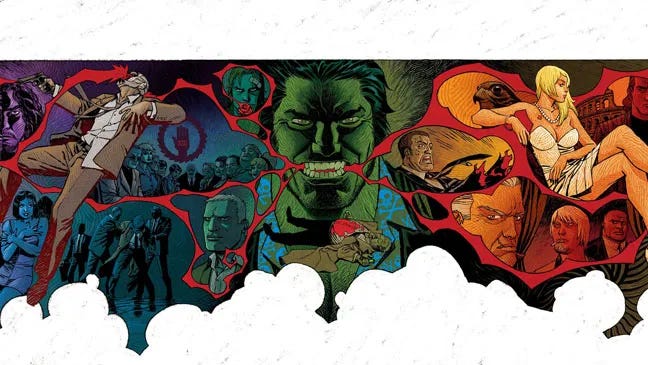
MA: Was there any particular reason why Alonso picked you to draw JOHNNY DOUBLE and 100 BULLETS, something that would link you to detective story comics?
ER: Well, that's like saying that Azzarello only writes detective stories, isn't it?
MA: To France, Argentina, and Italy you did different genres, but for those who only know your American work...
ER: Ah, OK, in the American market. Azzarello has written superheroes, too. Right now, I'm doing BATMAN... yeah, the story has a darker detective story feel to it than other writers' stories, but that's because Azzarello likes it that way. I'm professional enough to do something different tomorrow if I'm asked to.
I don't like superheroes because I don't believe in them. I don't believe in superheroes, but I'd take the challenge to do Spider-Man or Super-Man.
MA: Was there any special reason for Alonso to hire you to do JOHNNY DOUBLE?
ER: With me, Alonso did something that editors usually don't do, especially Alonso. With me, he overlooked steps. Usually, a new artist gets to do a short story, I mean, like a chapter or something, to see the artist's reaction to the story. It's a kind of adaptation, a way of introducing him to the works. With me, he overlooked that step and gave me a mini-series, which was JOHNNY DOUBLE, because I showed him all the work I had published in Europe.
He only knew my work with Aliens and some short stories for Heavy Metal, and he liked my drawing, but when he saw all my work, he said "Dammit! It shows you're a professional and you're good for something more." And so, he gave me JOHNNY DOUBLE.
MA: What about your relationship with Azzarello, did you get along right away?
ER: We got along right away because of what I told you before. I showed him, both him and Alonso, that I could do more than they asked me to; I could go beyond the script. I always go beyond the script, it's more fun for me.
So, I don't know. I ask Azzarello not to tell me what's going to happen in 100 BULLETS' or Batman's next issue. I have an idea, but I don't like to know what's going to happen.
MA: Aren't you curious to find out how the series is going to end?
ER: No. Because I feel more like a reader. I don't read comics anymore these days. I mean, I look at what authors present to me, or what my friends or people related to my studio share, but I don't actively read comics like I used to. I used to read a lot of comic books, but not anymore. And since I don't read them, I like to feel like a reader when I get down to drawing, and that's a challenge.
MA: 100 BULLETS was supposed to run for 12 issues, but now it's going to run for 100 issues.
ER: Any new series must have 12 issues, it's a publisher's requirement. If the sales are up, it goes on; if it doesn't, the title is dropped, and you move on to something else.
MA: When did you decide that the series would have 100 issues?
ER: After a year we knew the sales were up and that it had a future.
MA: 100 issues mean six to seven years. Doesn't the idea frighten you?
ER: No, quite the opposite; the idea of growing artistically with the series thrills me. It's also a personal challenge. And besides, the possibility of the series developing and growing with me, professionally, is also attractive, isn't it?
MA: BATMAN: BROKEN CITY was meant to be an OGN. Why did it become a monthly series?
ER: Because Jim Lee, who is a friend of both mine and Brian's, talked us into it. He likes our work, and he talked us into going on with the series once he finished his run.
And then, well, Jim's word has a lot of weight in the company, and he talked the editors into it; and when the editors asked us "You want it? Can we get it going?" Well, it just sped all the deadlines, and today we have so little time that it's almost too much for me. Before I came here [to Amadora, Portugal], I did 11 pages in just eight days to conclude the third issue. It's too much!
But we were very late with 100 BULLETS and Batman because Batman was supposed to happen two years from now.
MA: Is there any character from the Batman Universe that you'd particularly like to draw?
ER: No, I just know Penguin and Joker. For instance, I had to draw the Killer Kroc, and I had seen Jim Lee's Killer Kroc, who had turned him almost into a dinosaur. I made him a bit more gangster-like, more human, although I believe that, historically, he used to be more human-like. But I didn't attach myself too much to other artists' work; I always try to make my work influence others. For instance, in issue three Ventriloquist shows up, and... Well, my assistant told me directly that the Ventriloquist wasn't like that, he was chubbier and fat. O.K., I see the character's characteristics and then I make them my way. I thought "What does a mad Ventriloquist look like?" So, I drew him more tormented, more arrogant. Because he suffers from his madness, I drew him more independently, without getting much attached to what had already been done.


MA: Did you change your approach to the page layout, your drawing, to Batman?
ER: That was my idea. Somehow, when I start something new, to me it's always a challenge, a new challenge, and since it's a challenge I see if I can change something. But I always end up thinking about the reader, so I try not to be aggressive.
I aim to engage and captivate the reader. Batman's audience differs from that of 100 BULLETS, so I try to appeal to Batman readers to draw them into 100 BULLETS.
Anyway, I think we have a different product from what Jim Lee and Jeph Loeb had been doing, and we are sure to lose many readers, especially the younger ones, because our Batman is a more grown-up reading, so it won't be possible to keep all the title's readers.
MA: Why don't you draw covers?
ER: Because a cover must sell, and that means it needs time to be done. Basically, I want to tell stories and that already takes much of my time, and I wouldn't, I couldn't possibly have time to do covers. I'd rather have someone who has the time to do them, someone who will do them better. And there are many.
MA: Have you ever thought about writing your own stories?
ER: I never had the need; I always had good writers. Besides, I like drawing. I'm sure someday I'll write a story, and it will surely be drawn without any text.
MA: Do you prefer seeing your work published in color or in black and white?
ER: I primarily work in black-and-white without considering color. This is because, firstly, I come from a black-and-white school, the Argentine school. Secondly, in the American market where I currently work, I have a talented colorist, Patrícia Mulvihill, who knows how to choose the right colors to complement my artwork. However, in the American market, you never know what kind of color treatment you're going to get—it can be excellent, or it can be poor. If you don't have a good colorist, your work can suffer in quality because of the color. So, I prefer to focus solely on the black-and-white aspect of my work.
MA: What are you thinking about doing after you finish BATMAN and 100 BULLETS?
ER: Right now, I'm thinking about finishing BATMAN and continuing with 100 BULLETS. I find 100 BULLETS much more attractive; it has a very interesting story to follow when you're drawing, but mostly we think alike - both me and Azzarello - if we start it, we finish it.
// end transmission
Until the next time, be happy.
Miguel Ardan